Orecchiette with Broccoli Sauce | Pasta Social Club
Orecchiette with Broccoli Sauce
30 mins prepServes 4
I thought I’d share a couple of excerpts from the book for this Pasta of the Month, excerpts featuring my favorite pasta of all: orecchiette, “little ears” from Puglia.
I love orecchiette because they’re as fun to make as they are to eat.
Orecchiette
Make the dough
Make your dough of choice and let it rest, tightly covered, at room temperature for 20 minutes.

Set up your workspace
Dust a sheet pan with semolina or line it with a dry dishcloth. Gather your tools.

Roll the dough into a rope
Cut off a slice of dough, about the width of one or two fingers. Keep the rest covered.

Roll the dough into a ½-inch (1.25-cm) thick rope. Start in the center and use your fingers or the palms of your hands to roll the dough, first back and forth, until the surface is smooth, and then outward in opposite directions, eventually making your way toward the ends. If the dough slides and it’s difficult to get a grip, wet your hands a little and try again. The rope does not need to be perfectly even.

Cut the rope into pieces
Cut the rope into roughly ½-inch (1.25-cm) pieces.

Make the orecchiette
Place a nugget of dough on your work surface. Then use the serrated edge of a table or butter knife to drag the dough toward or away from you, with firm pressure, tilting the blade downward into the dough at a 30- to 45-degree angle, until the dough curls over on itself like an ocean wave crashing on shore. If dragging the dough toward you, you can use your non-dominant index finger to apply more pressure on top of the tip of the knife as you drag for more control.

Don’t be shy with the pressure; the more tension you feel between the dough and the knife, the rougher the surface will be, which will help catch sauce.

Peel the curled edges apart with your fingers and invert the dough over your thumb to expose the rough interior, stretching it a little into a small dome.

Arrange the finished orecchiette, rough side up, in a single layer on the prepared sheet pan. Repeat with the remaining pieces, and then the remaining dough. If you have the time, let the pasta dry for an hour (or up to 5 hours) before cooking.


Broccoli Sauce
Bring a large pot of water to a boil and season it generously with salt. Break the broccoli into small florets, then trim and peel away the tough outer layer of the stalk and cut it into bite-sized pieces. When the water is boiling, add the broccoli and cook until tender, about 7 minutes.

While the broccoli cooks, warm the oil over medium heat in a large sauté pan or Dutch oven. Add the onion, along with a pinch of salt and pepper, and cook until softened, stirring often, about 5 minutes. Stir in the garlic and red pepper flakes and cook for 2 minutes more.

With a slotted spoon, transfer the broccoli and a splash of its cooking water directly to the pan with the onion (reserve the cooking water). Reduce the heat to medium-low. If using fresh pasta, continue to cook the broccoli in the pan for 5 minutes, using a wooden spoon to break it down further; if using dried pasta, skip to the next step.

Add your pasta of choice to the broccoli cooking water and cook until just shy of your liking.* Keep breaking down the broccoli while the pasta cooks, stirring often. Season to taste.

*Substack note: Fresh orecchiette take approximately 3 to 5 minutes to cook, depending on thickness and drying time.

To serve
Transfer the pasta directly to the sauce, along with ½ cup (120 ml) pasta cooking water (if you need to drain the pasta first, make sure to reserve a little more cooking water than you might need). Continue cooking, stirring constantly, until the pasta is well coated, 1 to 2 minutes. Turn off the heat and stir in the cheese and lemon juice.

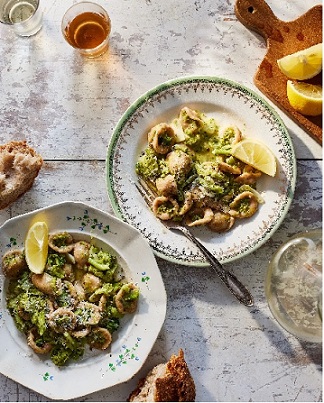
Divide the pasta among bowls and serve, topped with lots of black pepper and more grated cheese.